I went through twelve years of school and four years of college, and in all of those years not a single hour of any single class was spent teaching me anything about money. I learned algebra. I learned the periodic table by heart. I learned Newton's three laws of motion. I learned, vaguely, how to balance chemical equations. I did not learn what an asset was. I did not learn what a liability was. I did not learn what compounding does to a small sum over thirty years. I did not learn what the cost of a loan actually is once you do the math. I did not learn any of it.
And this was a good school, by Indian middle-class standards. The teachers were earnest, the syllabus was thorough, the marks were honest. The omission was systemic.
For nearly twenty years after school ended, I assumed that what I had not been taught was simply unimportant. School, after all, had spent so much time on what mattered. If money had mattered, school would have covered it. It must be something the smart people pick up on their own, somehow.
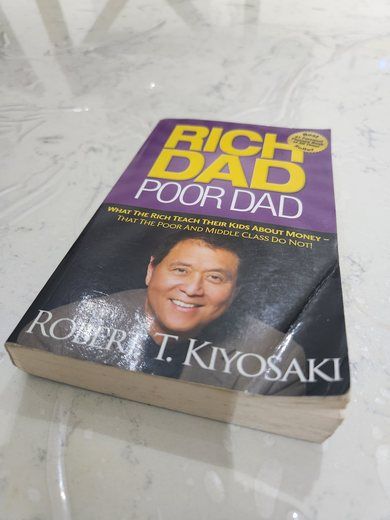
It was Rich Dad Poor Dad — Robert Kiyosaki's much-mocked, much-loved book, the one almost everyone has heard of and almost nobody actually reads carefully — that finally gave a name to what had been missing.
The name, as it turns out, is financial intelligence.
"Intelligence solves problems and produces money. Money without financial intelligence is money soon gone."
Kiyosaki is, throughout the book, almost laboriously clear about one thing: financial intelligence is its own form of literacy, and it has very little to do with being smart in the school sense. You can have a Ph.D. and be financially illiterate. You can also leave school at fourteen and be financially shrewd. The two skills are simply not the same skill, and pretending they are — assuming the smart people in your life are also the wise-with-money people — is one of the great quiet errors of middle-class life.
"Illiteracy, both in words and numbers, is the foundation of financial struggle. If people have difficulties financially, there is something that they don't understand, either in words or numbers."
I read that passage and felt a small, embarrassed click of recognition. I had, for years, looked at my own modest savings, my own modest investments, and my own modest understanding of what they were actually doing, and quietly assumed the gap was a personal failure. Kiyosaki was telling me, gently, that the gap was a literacy gap. I had been trying to read a language nobody had taught me to read.
He also says, with a dry insistence that runs through the whole book:
"If you want to be rich, you've got to read and understand numbers."
Which is the kind of sentence you nod at the first time you read it, and only really feel the weight of the third or fourth time.
The asset column
If financial intelligence has a most concrete, most immediately useful component — the one even a fourteen-year-old can grasp in five minutes and benefit from for the next sixty years — it is the asset-versus-liability distinction Kiyosaki keeps returning to.
An asset, in his definition, is anything that puts money in your pocket. A liability is anything that takes money out of your pocket. That is the whole framework. There are no other categories.
The painful realisation, for most middle-class adults, is that the things they have been taught to think of as assets — the bigger house, the upgraded car, the impressive wardrobe — are almost all liabilities under Kiyosaki's definition. They cost money to maintain. They depreciate. They drain the salary every month. They do not produce income. They look like wealth. They are, in fact, anti-wealth.
"Rich people buy luxuries last, while the poor and middle class tend to buy luxuries first. The poor and the middle class often buy luxury items like big houses, diamonds, furs, jewellery, or boats because they want to look rich. They look rich, but in reality they just get deeper in debt on credit. The old-money people, the long-term rich, build their asset column first. Then the income generated from the asset column buys their luxuries."
I read this paragraph at forty-one and felt a strange double-feeling — partly the embarrassment of having spent fifteen years half-doing the wrong version of being good with money, and partly the relief of finally being shown the right version. The right version is not glamorous. Build the asset column first. Buy luxuries with the income the assets generate. That is the entire secret. The fact that I had not been told this once, anywhere, in twenty-two years of formal education, struck me — and continues to strike me — as a strange and serious failure of the school system.
The cleanest example in my own life of this lesson came late. For most of the years I had been buying motorcycles — the first three of them between 2013 and 2019 — I was doing exactly what Kiyosaki warns against. The bikes were paid for out of income. They were liabilities I bought because I wanted them, dressed up in the rationalisation that they were rewards. It was only the last two of the five — one at the end of 2021, one in April 2023 — that I paid for entirely from profits the stocks I owned had quietly thrown off. Not one rupee for those two bikes came from anywhere but the stocks themselves. That was not yet Kiyosaki being applied with discipline — I had not yet read him. That was the framework being applied by hard-won experience, by a slightly older version of me who had, by then, learned through other and more expensive means that there are right ways and wrong ways to fund the things you want to own. (The story of how I learned that distinction — the more expensive way of learning it — is its own article on this site.)
Behaviour over IQ
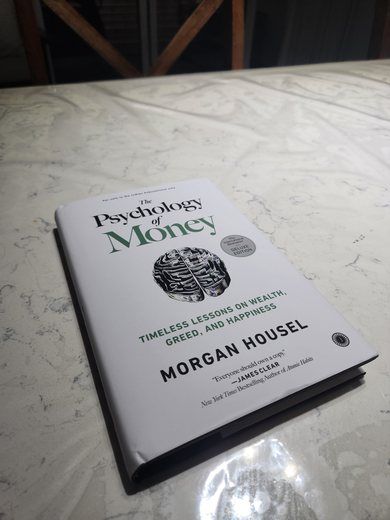
The piece of evidence that closed the loop on all of this for me did not come from Kiyosaki at all. It came from Morgan Housel, in The Psychology of Money, and it is one of the most quietly devastating sentences in any of the books I have read over the last year and a half.
"Ordinary folks with no financial education can be wealthy if they have a handful of behavioral skills that have nothing to do with formal measures of intelligence."
Read that line slowly. It is saying something extraordinary. It is saying that the people who quietly build wealth in this world are very often not the cleverest, the best-educated, or the highest-earning. They are the people with a handful of behaviours — saving regularly, refusing the obvious shortcuts, not interrupting the math, ignoring what their neighbours are doing — that have nothing whatsoever to do with IQ or degree certificates.
Which means the door to financial intelligence is, in a sense, unlocked. You do not need to be brilliant to walk through it. You need to be disciplined and patient and willing to look slower than your peers for ten or fifteen years. That is a very different kind of skill from the one school measures. It is, in fact, almost the opposite kind of skill.
The fastest learners, the highest scorers, the children with the gold stars — they have no advantage here. None. The advantage belongs to the patient.
What I am teaching my boys
The reason all of this matters more to me, today, than almost any other lesson I have absorbed from the books — is that I have two sons. The elder is fourteen. The younger is thirteen. They are in school now. And I know, with a quiet certainty, that they will not learn any of this in any of the years that remain of their formal education.
So I am teaching it myself, in the small ways one can teach anything to a teenager. There are notebooks of their own, in their own handwriting. There are conversations I would not have had in this form even five years ago — about the difference between buying something to own and buying something to maintain, about why a small SIP started at fifteen is worth more than a large one started at twenty-five, about why looking rich and being rich are almost opposite states of being.
There is a particular reason this matters for them at this age, and not just for them in general.
A fourteen-year-old who absorbs the asset-versus-liability distinction now can be where most adults are not until their late forties. They can have a meaningful portfolio by their early thirties. They can be financially secure — truly secure, in the sense of not needing the next pay-cheque to land for the household to function — by their late thirties. By the time their friends are buying their first homes on twenty-year EMIs, they can be the ones buying outright. None of this requires waiting until sixty-five to see the reward. The earliest rewards come somewhere in their late twenties, and the substantial ones come somewhere in their thirties. That is not financial magic. That is just the math working from a starting point that almost nobody ever gets.
A forty-year-old who absorbs the same idea has less runway and more catching up to do. The principle still works — there is genuinely no age at which it stops working — but the leverage is much smaller, and the patience required to wait for the math is much harder when half of working life is already behind you.
There is also the matter of identity. At fourteen, the way they think about money is still being formed. If "I am someone who saves, who tracks, who thinks before I buy" becomes part of who they think they are now, it has a real chance of calcifying into who they actually are by twenty-five. If it does not, they will spend most of their twenties trying to install habits that someone — anyone — should have installed at thirteen.
And there is the matter of what is coming for them in seven or eight years, when their first salaries land in their accounts and a wave of cleverly designed consumer pressure breaks over them — credit cards offered as perks, EMIs offered as kindness, lifestyle upgrades offered as basic dignity.
My own response to that wave, when it broke over me in my early twenties, was simply to not get on the boat. I have never owned a credit card. I have never used one. I have politely refused every offer the banks have sent me over the last twenty years. I want to be very clear that this is my personal preference and not advice — credit cards have real, well-documented advantages, and a great many people use them sensibly and benefit from them in ways I would not want to argue with. It is just that I happen to prefer the small daily friction of spending only what is already in my account. The debit card has been enough for me for twenty years and is likely to be enough for me for another twenty. That is a choice of temperament more than a recommendation. But it is the choice I will quietly suggest to my boys, when their time comes.
Pre-existing financial literacy — whatever specific shape it takes for the person learning it — is the only real shield I can think of against the wave when it arrives. And the shield has to be built early. By the time the wave hits, it is too late to start building it.
This, I think, is the deepest thing the books have given me. They have not made me wealthy. They have not, by the conventional measures, made me much smarter than I was at forty. What they have given me is a literacy I should have been given at fourteen, and the chance to pass that literacy on to two boys who are fourteen and thirteen right now, before the school system has a chance to convince them, as it convinced me, that what was not taught was not important.
— Rex
A side-piece adjacent to Book of Books — The Things That Struck Me. The companion piece on saving and independence is here: The books that taught me what money is actually for. The numbered series starts with Part 1 — The book that taught me about wanting and continues with Part 2 — The book that taught me about compounding. The longer essay this all grew out of is here: Make Money While You're Young.