For most of my working life — and I started working at twenty-one, which means almost all of my adult life — if you'd asked me whether I wanted to be rich, I'd have said yes without thinking much about it. Of course I wanted to be rich. Doesn't everyone?
That was Robert Kiyosaki's first move on me. He took that yes — the easy, automatic, never-really-examined yes — and held it up to the light.
I was forty-one when I finally picked up Rich Dad Poor Dad, one of the early books I read after the habit took hold. I came to it the way I came to most of the books I read in that first wave — with some leftover skepticism, certainly (bestsellers tend to acquire a faintly suspicious shine, like everyone in the world is selling them on commission), but mostly with the simple fact that for twenty years I had not been a reader. The book had been sitting on shelves around me all of my adult life, and I had walked past it the way I had walked past every book — politely indifferent, eyes elsewhere. The faint suspicion only kicked in once I actually picked it up, and even that softened by the second chapter.
The three levels
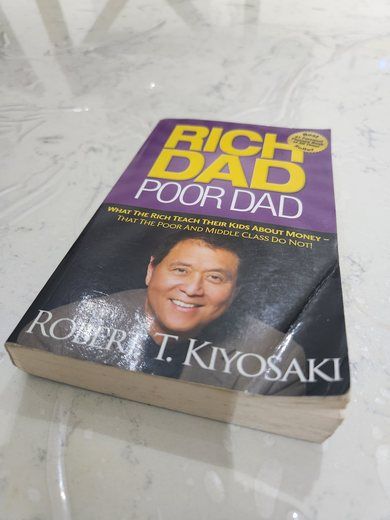
The line that stopped me was simple. There are three levels of wanting, Kiyosaki writes. The first level is "I want to be rich" — which is really, when you say it out loud and listen honestly to yourself, just "I'll take it if it falls in my lap." Wanting alone, he warned, leads only to more wanting. A perfect circle that goes exactly nowhere.
I read that sentence and the years rearranged themselves behind me.
I had been doing a version of level one for almost two decades. Not the spending-and-borrowing version — I had stopped being careless with money in my mid-twenties, somewhere around twenty-six, and quietly started setting aside small amounts every month, with a tiny portion finding its way into a couple of modest mutual fund SIPs. After Reeba and I married, and especially after the boys arrived, that habit only deepened. The salary came in, the responsible part of it went straight into savings and the small investing I had going, the rest covered what life cost. By the conventional measure of being-good-with-money — don't borrow, don't show off, don't blow it on weekends — I had been doing the right things for almost fifteen years.
But Kiyosaki was not asking about that.
He was asking about the next layer. Are you saving with a destination? Do you know what you are saving for, in concrete terms — what number, what structure, what kind of life it is meant to buy you in ten or twenty years? Do you have any plan more specific than I will figure it out when there's enough?
I did not. The saving was a habit. The destination was a fog. And in that sense I had been wanting in the same way I had been wanting to be fitter, or to read more, or to spend more time with my parents — in the manner of casual aspiration, with no concrete decision attached, no direction, no plan.
What level two of wanting looks like, the book taught me, is harder to write down. It involves an actual decision — I am going to act on this. It involves direction: what exactly does "rich" mean to me, what's the number, what's the structure that gets me there, who am I willing to disappoint to do it. Level three is harder still — it's the practice of acting on that decision, day after day, when nothing visible is changing and your friends are spending freely and the easier path is to drift back to level one.
The mirror
I am, at forty-three, only just learning what levels two and three feel like in practice. The notebooks I bought for my two boys, where they track every stock and mutual fund they invest in. The SIPs I finally set up. The site you are reading this on, written one slow article at a time. These are level-two acts. They are not yet level three — in the sense that I have not been doing them for ten years yet. But they are no longer level one.
What Kiyosaki gave me — what he gives anyone who reads him honestly — is a small mirror held up to your own yes. The next time someone asks if you want to be rich, the question to listen for is not what you answer but what you do with the answer the next morning.
If the answer is nothing, you don't really want it.
You just hope you have it.
— Rex
This is Part 1 of Book of Books — The Things That Struck Me, a 10-article series on the books that changed how I think about money, mindset, and life. Part 2 — on compounding — is coming next. If you'd like the longer essay this series grew out of, it's here: Make Money While You're Young.