There are two words in English that we use almost interchangeably, and shouldn't. We say a man is rich. We say a man is wealthy. If you ask most people what the difference is, they'll shrug — rich, wealthy, same thing, just different ways of saying he has a lot of money. I don't blame them. I would have said the same thing at twenty-five. But the two words point at completely different lives, and learning to tell them apart is one of the more useful things I've done in mine.
The book that first showed me the gap, although it never used those exact two words, was Robert Kiyosaki's Rich Dad Poor Dad. Most people remember it for the contrast between his two fathers — the educated, salaried, perpetually-broke biological father, and the school-dropout, business-owning, eventually-rich father of his best friend. The book has been beaten up by critics over the years, and some of those criticisms are fair. But there is a single sentence in it that, for me, was worth the price of the entire book and then some.
The sentence
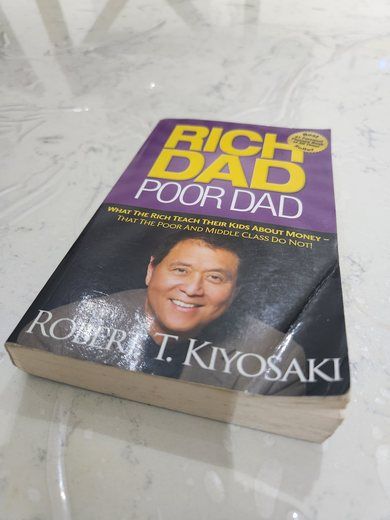
Kiyosaki writes, late in the book and without much ceremony:
"It's not how much money you make, it's how much money you keep, and how many generations you keep it for."
The first time I read that line, I almost didn't notice it. Of course you have to keep some of what you make — everyone knows that. It sounded like the kind of obvious advice that obviously-rich people repeat in their interviews. I marked the page out of habit and read on.
But the sentence stayed with me. I came back to it, in my head, over the next few days. And the longer I sat with it, the more I realised it was not obvious at all. It was, in fact, the entire game, in a single sentence.
Most of us spend our whole working lives optimising the first half of that sentence. We try to get a better job, a bigger raise, a more lucrative side hustle. The whole financial conversation in our heads is about how much money I make. The second half — how much I keep — barely enters the conversation. And the third half, the generations one, is so far outside the frame that most people don't even know it's a question they should be asking.
But the math is brutal. A man who earns twenty lakhs a year and spends twenty lakhs a year ends every year with nothing. A man who earns eight lakhs and spends six ends every year two lakhs ahead. In the first man's column the number that says income is bigger, and in his lifestyle the visible signs of money are louder — the bigger car, the better address, the family holiday photos on the phone. But at the end of a working life, the second man owns his life and the first man owns a wardrobe of well-dressed receipts.
Rich is what they see. Wealthy is what they don't.
This is the distinction the language has been quietly hiding from us.
Rich is visible. It is the SUV in the driveway, the apartment in the right neighbourhood, the watch on the wrist, the school the children are sent to, the family holidays paid for on EMI. It is, almost by definition, performance — rich is something you do for an audience. It announces itself. It needs to be seen to function as rich.
Wealthy is invisible. It is the investments quietly compounding in a corner of a portfolio nobody else is looking at. It is the ability to take three months off work without panic. It is sleeping well at night because nothing in your life is funded by next month's salary. It is, fundamentally, the absence of fear about money.
A man can be both, but rarely is. Far more often, a man is one without the other — and the world we live in pushes us, every single day, toward the wrong one of the two.
The boss with the new SUV in the driveway is rich. The quiet old man down the road who has owned his small house outright for thirty years is wealthy. We notice the first man. We don't notice the second. He looks like nothing, because being wealthy looks like nothing to people who don't know what they're looking at.
Why the world is set up to make you rich, not wealthy
Almost every commercial force in modern life is engineered to convert your money into the appearance of richness as quickly as possible, before you have a chance to become wealthy with it.
Salary credits on the first of the month, EMIs scheduled to debit on the fifth. New phone every twelve months, on a "no-cost" plan. Holiday packages with the deposit deductible upfront. Car loans, lifestyle loans, festive offers, dynamic pricing that scales with your apparent income. The system has been refined, over decades, to draw down whatever you make as efficiently as possible, leaving you with just enough to want the next thing.
None of this is a conspiracy. It is just what businesses do, working at scale, on attention spans we keep generously offering them. But the cumulative effect is that being rich — living a life that looks expensive — is the default outcome of doing nothing in particular. Becoming wealthy — building something that lasts — requires conscious, almost stubborn, resistance.
You have to actively choose to save when everything around you is built to make you spend. You have to actively choose to keep an older car when every advertisement insists you upgrade. You have to actively choose to live below your visible station so that an invisible one can grow.
It feels, for a long time, like losing. It feels, for a long time, like you are the only one being sensible while everyone around you is living larger and having more fun. And then one day, twenty years later, you look up and notice that several of those people are exactly where they were — one paycheck from a problem — and you are no longer.
The generations question
I want to return, briefly, to the last six words of Kiyosaki's sentence, because they're the part most people skip past.
". . . and how many generations you keep it for."
This is the part of the question that most of us never get to, because we've barely answered the first two. But it is, in the long run, the most consequential of the three.
It asks: am I building something that ends when I do? Or am I building something that continues? Will my children inherit habits, assets, and a head start? Or will they inherit a fresh blank page and have to start the same struggle I did, just to get to where I am now?
I don't want to overstate this. Not every family needs to be a dynasty, and there is something to be said for the dignity of each generation making its own way. But the people I respect most are the ones who think in generations — who plant trees they may never sit under. Most financial planning in modern India ends at retirement, as if the person who lives the longest in the room wins. The Kiyosaki framing rejects that. The point isn't to die having held the most. The point is to leave more behind than you found.
What I'm doing about it
I don't make these choices perfectly. I have spent money on things I didn't need, including some I now look at and quietly wince about. I drive a car that is, by any reasonable measure, more than I strictly need. I am not a hermit and I don't want to be one.
But the question I now ask myself, before any non-trivial spend, is some version of: am I making a rich choice, or a wealthy choice? The new phone every year is a rich choice. The two extra mutual fund SIPs are a wealthy choice. The lifestyle upgrade financed on EMI is a rich choice. The boring index fund nobody at a dinner party wants to hear about is a wealthy choice.
Most days, the rich choice is louder and more inviting. The wealthy choice is quieter and feels less rewarding in the moment. But the wealthy choice has one quality the rich choice never has: it adds up. Twenty years of small wealthy choices compound into a life with options. Twenty years of small rich choices compound into a slightly more comfortable form of being trapped.
If I have only one thing to pass on to the next person reading this in their twenties, it is this: when you're given a choice between looking rich and being wealthy, choose wealthy. Almost every time. The world will think you're being boring. Your bank account, your sleep, your spouse, and your children — eventually — will thank you.
It's not how much money you make, it's how much you keep, and how many generations you keep it for.
The entire game, in one sentence.
Next in the series: Part 4 — The Book That Taught Me About Mindset. On T. Harv Eker's Secrets of the Millionaire Mind, and why the inner game decides the outer one.