The first three parts of this series were about the outside of money — the wanting of it, the compounding of it, the difference between merely having it and being quietly wealthy with it. But there is a quieter layer underneath all of that. A mental layer. It decides whether any of the outside lessons actually take root in a particular life. The book that opened that layer up for me was T. Harv Eker's Secrets of the Millionaire Mind.
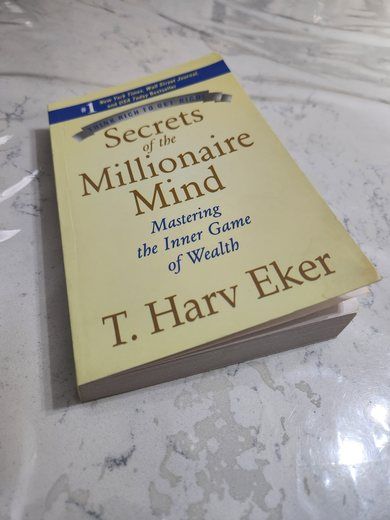
Eker is not a subtle writer. The book is built around seventeen short contrasts — he calls them Wealth Files — between how people who tend to get wealthy think, and how people who tend not to. Some of these felt a little on the nose. A few quietly stayed with me. This piece is about those few.
I have picked ten of the seventeen and grouped them into four clusters — who you think you are, where you look, how you relate, and what you do with money. Together they read as a kind of inside-out map. Eker uses the words rich and poor bluntly; I have left his quotes exactly as he wrote them, because softening them would change what he meant.
WhoWho You Think You Are
Two principles about the bedrock — the version of yourself you start the day as.
This is the foundation of everything Eker writes about. If you secretly believe your life is happening to you — that your boss, your parents, your circumstances, your bad luck are the real authors — you will never quite take the wheel. Everything else in the book assumes you have already decided you are the one driving. Until that decision is made, the rest is just reading.
The fear does not disappear for the people who act. They are just as scared. The difference is what they do with the fear — not remove it, just refuse to wait for it to leave. Most of the moments in life that turn out to matter were entered while the body was still saying no.
WhereWhere You Look
Three principles about the direction of attention. This cluster is, for me, the heart of the book.
When something new shows up — an offer, an idea, a half-invitation — the first thing your attention does, shapes more of your life than almost any other single habit. The obstacle-first mind thinks it is being careful. It is, in fact, just being faster than the opportunity-first mind at the question of what is wrong with this. Both questions need answers. The order matters.
This is the harder one to recognise in yourself, because playing not to lose looks exactly like being responsible. The defensive job, the safe investment, the no said to anything risky — all of these can be either a wise choice or a small failure of nerve, and from the outside they are indistinguishable. The only way to tell which is to ask: am I doing this because I'm aiming for something, or because I'm avoiding losing something? One of those two questions builds wealth. The other just preserves the current amount.
This one sounded slightly silly to me the first time I read it — of course we are told to think big, every motivational poster has been saying so for fifty years. But Eker means something specific. The size of what you allow yourself to want is, for most people, the actual ceiling of what they will ever get. Wanting bigger is not arrogance. It is a permission slip, you write to yourself, and most of us have never written one.
HowHow You Relate
Three principles about your stance toward other people — the successful ones, the generous ones, and the teachers you haven't met yet.
This one cuts close, especially in cultures where quietly resenting the visibly successful is almost a social ritual. The person you secretly dismiss is the person you will never let yourself become. You do not have to copy them. You only have to stop subtracting from them in your head. The respect is not for their bank balance. It is for the version of you that might one day exist.
This is the one I find the hardest. Of all ten on this list, this is the one I have not really managed to put into practice, even now. Someone offers to pay the bill at dinner and I will not let them. Someone offers to help with something and my reflex, before I have even thought about it, is to say no, I'll manage. Even reading what I just wrote, a part of me still thinks: but that's just being humble, isn't it? That's just being a decent person.
Eker's point — and I think he is right, even though I struggle to live by it — is that this is not humility. It is a kind of resistance. The world is always trying to give us things — money, chances, introductions, help, kindness. If our reflex is to deflect, to repay too quickly, to insist on doing it alone, we quietly close the tap. The flow of good things slows down. We are so busy proving we don't need anything that we stop being available for the things we actually do.
I don't have this one solved. I am working on it the way you work on any old habit — slowly, with some failures, with the goal of just pausing a little longer the next time someone wants to give me something, before the old reflex takes over.
The most dangerous sentence anyone can say to themselves is I know how this works. It usually means: I have stopped paying attention. The people who keep learning treat every new situation as if it might teach them something they don't already know. The people who don't, treat every new situation as a chance to re-confirm what they already think. The first kind grow. The second kind harden.
WhatWhat You Do With Money
And finally, two principles about money itself — the structural shifts that change the financial outcome.
Most people, asked how much money they have, will tell you their salary. That is not how much money they have. It is how much money they are currently being paid. The two are completely different things. Net worth — what you own minus what you owe — is the number that actually tells you where you stand. Once you start tracking it, even casually, every spending decision rearranges itself.
The full life of working for money has a ceiling, and that ceiling is your time. There are only so many hours. Money working for you — through investments, through ownership, through assets that earn quietly in the background — has no such ceiling. The transition from one to the other is the entire long arc of building wealth. It does not begin with a large amount. It begins with the first hundred rupees you put somewhere that pays you back, instead of somewhere that doesn't.
What I do with all this
I have not followed Eker's seventeen Wealth Files like a checklist. Nobody does, and the people who claim to are usually selling something. What I have done, slowly, is internalise these ten — let them become questions I quietly ask myself when I notice something happening in my own head.
Am I creating this or having it happen to me? Am I playing to win or to not-lose? Where is my attention going first? Am I admiring this person or quietly resenting them? Am I receiving this gracefully or deflecting it? Am I tracking my net worth or just my salary?
That's mostly it. No system. No notebook. Just a handful of questions that have, over time, become slightly louder than the older voices that were there before.
If I have one thing to pass on from this part of the series, it's this: the inner game and the outer game are not two separate games. You can read every personal finance book ever written, and underline every line, and still not change anything — because the older mind inside you keeps reaching for the obstacle before the opportunity, the safety before the chance, the comfort before the discipline. Changing what you do with money starts with changing the older mind. Eker's seventeen, or his ten that mattered to me, are one good way to begin.
Next in the series: Part 5 — The Book That Taught Me About Ownership. On Felix Dennis's How to Get Rich, and the difference between earning money and owning the thing that earns it.